
How to Treat Bamboo for Construction: A Beginner’s Guide to Borax
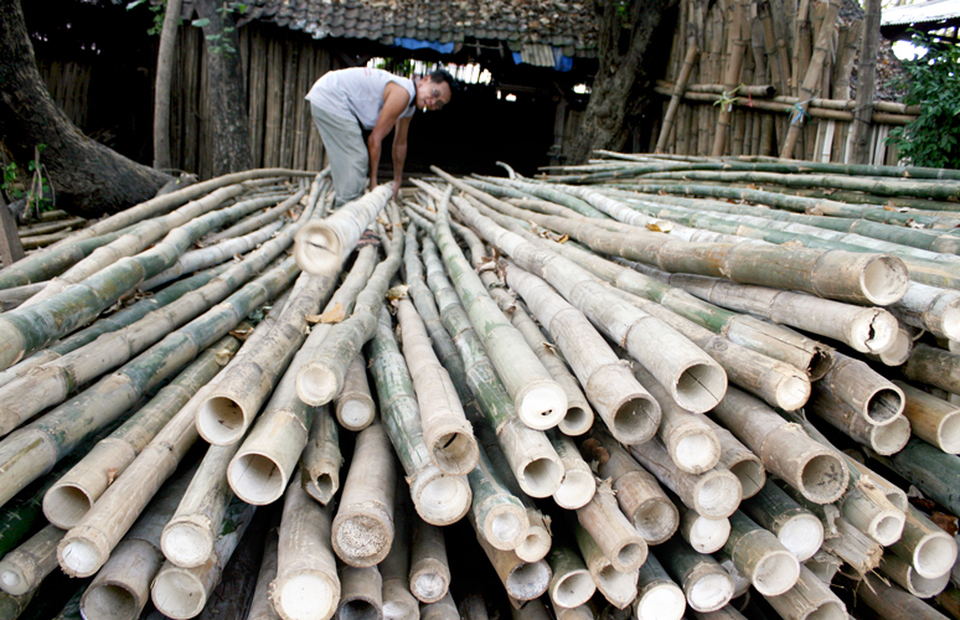
There is a persistent myth in the construction world that bamboo is a temporary material. Skeptics often point to bamboo fences or agricultural sheds that turn black, crumble, and collapse after just three to five years.
They aren’t entirely wrong—but they are missing a crucial piece of the puzzle. Untreated bamboo is temporary. Properly treated bamboo, however, can last over 50 years, rivaling the lifespan of standard structural timber.
If you are planning to build a sustainable home, an eco-resort, or even a simple off-grid pavilion, understanding how to treat your materials is the single most important skill you can learn. Building a stunning, structurally sound bamboo house means absolutely nothing if it gets eaten from the inside out within a year.
Here is your beginner’s guide to the science of bamboo degradation, the magic of the Borax treatment, and how to protect your eco-build for decades to come.
The Enemy: Sugar, Starch, and the Powder-Post Beetle
To understand why we treat bamboo, we must understand what it is. Bamboo is a giant grass. When harvested, the culm (the hollow pole) is packed with natural sugars and starches.
For humans, this makes bamboo shoots a delicious meal. For insects—specifically the Dinoderus minutus, commonly known as the powder-post beetle—mature bamboo is an all-you-can-eat buffet. These beetles burrow into the bamboo, lay their eggs, and the resulting larvae eat the starch-rich interior. You will often know you have an infestation when you see tiny piles of fine, sawdust-like powder accumulating beneath your structure.
Furthermore, these natural sugars make untreated bamboo highly susceptible to fungal decay and rot, especially in humid tropical environments.
The Solution: Borax and Boric Acid
Historically, indigenous communities managed pests by harvesting bamboo during specific lunar cycles (when starch content is naturally lowest) and soaking the poles in muddy riverbeds or saltwater for weeks to leach out the sugars.
Today, modern eco-construction relies on a highly effective, environmentally friendly, and affordable chemical alternative: Boron-based salts.
Specifically, builders use a mixture of Borax (Sodium tetraborate) and Boric Acid.
- Why it works: Borates do not just poison the insects; they fundamentally alter the starch inside the bamboo so that it can no longer be metabolized by the beetles or fungi. It essentially turns their food source into an indigestible mineral.
- Why it is safe: Unlike highly toxic heavy-metal wood preservatives (like CCA-treated lumber), Borax is a naturally occurring mineral. It is roughly as toxic to humans and mammals as standard table salt, making it incredibly safe to handle on a build site and safe for the surrounding environment.
The Standard Treatment Ratio
Most bamboo treatment facilities use a localized variation of a 5% to 10% solution, typically mixing Borax and Boric acid in a 1:1 or 6:4 ratio dissolved in water. The Borax acts as a fungicide, while the Boric acid acts as a powerful insecticide. (Note: Heating the water slightly helps these salts dissolve completely).
The 3 Core Methods of Bamboo Borax Treatment
Knowing the chemical ratio is only half the battle. You have to get the solution inside the dense, fibrous walls of the bamboo. Because bamboo is compartmentalized by solid nodes, it does not naturally absorb liquids easily.
Builders typically use one of three primary methods to treat structural poles.
1. Vertical Soak Diffusion (VSD)
This method relies entirely on gravity and is excellent for small-scale builds or off-grid farms without heavy machinery.
The Process: Freshly harvested, green bamboo poles are kept upright. A long iron rod is rammed down the center of the pole to punch through all the internal nodes except the very bottom one. The hollow tube is then filled to the brim with the Borax solution. Over the course of 10 to 14 days, the solution slowly diffuses outward through the cell walls, replacing the sap and water.
2. The Submersion / Immersion Bath
This is the most common method for medium-to-large-scale commercial operations.
The Process: Poles are drilled with small holes near each node (so the liquid can enter the hollow chambers) or split entirely. They are then weighted down and fully submerged in a large concrete or lined pool filled with the Borax solution. The poles soak for 1 to 3 weeks, ensuring complete saturation.
3. The Modified Boucherie Process
For high-tech or rapid commercial processing, the Boucherie method uses pressure to force the treatment into the bamboo.
The Process: A pressurized cap is attached to the base of a freshly harvested, green bamboo pole. The Borax solution is pumped in at high pressure, literally pushing the sugary sap out the other end of the pole until the liquid running out is pure treatment solution. This can treat a pole in a matter of hours rather than weeks.
The Final Crucial Step: Drying and Curing
Treatment is useless if you do not cure the bamboo properly afterward. Once the poles are saturated with Borax, they must be air-dried.
Bamboo should never be dried in direct, harsh sunlight, as rapid moisture loss will cause the culms to split and crack, ruining their structural integrity. Instead, poles should be stacked horizontally in a well-ventilated, shaded area (often on a drying rack) for several weeks until their moisture content drops below 18%. Only then are they ready to be cut, joined, and built into a lasting structure.
Why You Can't Learn Treatment from a Blog Post
Reading about a 5% Boric acid ratio and looking at diagrams of Vertical Soak Diffusion makes the process seem deceptively simple.
In reality, bamboo treatment is an incredibly tactile, nuanced science.
- How do you identify the correct lunar cycle for harvesting to minimize your chemical usage?
- How do you punch through a node with an iron rebar without accidentally splitting the entire 6-meter pole?
- How do you test the moisture content by the sound and weight of the wood?
You cannot learn these physical skills through a screen. If you attempt to build a house based purely on online tutorials and you get the treatment phase wrong, your structure will fail.
Master the Supply Chain in Person
If you are serious about utilizing bamboo for architecture, farming infrastructure, or real estate development, you must learn the supply chain from the ground up. You need to get your hands dirty, mix the solutions, drill the nodes, and feel the material.
Ready to move from theory to reality?
Read our [Ultimate Guide to Bamboo Building Courses] to find the perfect hands-on immersion program. Whether you choose a community-rooted program like Bamboo Bootcamp in the Philippines or a luxury design course in Bali, taking an in-person workshop is the only way to guarantee your structures will stand the test of time.