
Why Indigenous Knowledge is the Missing Link in Modern Eco-Construction
The global architecture and construction industries are currently in a race to “go green.” Developers are pouring millions into specialized CAD software, attempting to engineer new ways to build with natural materials like bamboo, earth, and timber. We are seeing incredible, futuristic eco-resorts and sprawling tropical event spaces rising across Southeast Asia, all heavily marketed under the banner of sustainability.
But as modern engineering tries to reinvent the wheel, it is repeatedly stumbling over the unpredictable, organic nature of these materials. Why? Because the modern eco-construction movement is often missing its most critical foundation: the generational wisdom of the people who have lived with these materials for centuries.
If we want to build structures that survive tropical climates, we cannot just apply Western concrete-and-steel logic to giant grass. Indigenous knowledge is not a quaint historical footnote; it is the missing link in modern sustainable architecture.
Here is why true eco-construction must start with indigenous partnerships, and how community-rooted programs are changing the way we learn to build.
The Flaw in "Modern" Green Building
When standard contractors attempt to build with bamboo for the first time, they typically treat it like standardized lumber. They expect perfectly straight lines. They use pneumatic nail guns and rigid steel brackets. They harvest the material whenever it is convenient for the project timeline.
The result is almost always a failure. The steel brackets rust in the humidity, the rigid bolts cause the bamboo to split under the pressure of high winds, and the poles—harvested at the wrong time—are quickly devoured by powder-post beetles.
Modern architecture often approaches nature as something to be forced into a blueprint. But organic materials resist force. To build with them successfully, you have to understand their behavior, their life cycle, and their environment. This is not knowledge you can learn from a textbook; it is knowledge born from survival.
Enter the Matigsalug Tribe
In the highlands of Mindanao in the Philippines, bamboo is not an architectural trend or a luxury design aesthetic. For indigenous communities like the Matigsalug Tribe, it is a foundational element of daily life and economic survival.
The Matigsalug possess centuries of generational expertise in forestry, harvesting, and traditional joinery. They know exactly how a specific species of bamboo will bend before it snaps. They know how to read the landscape.
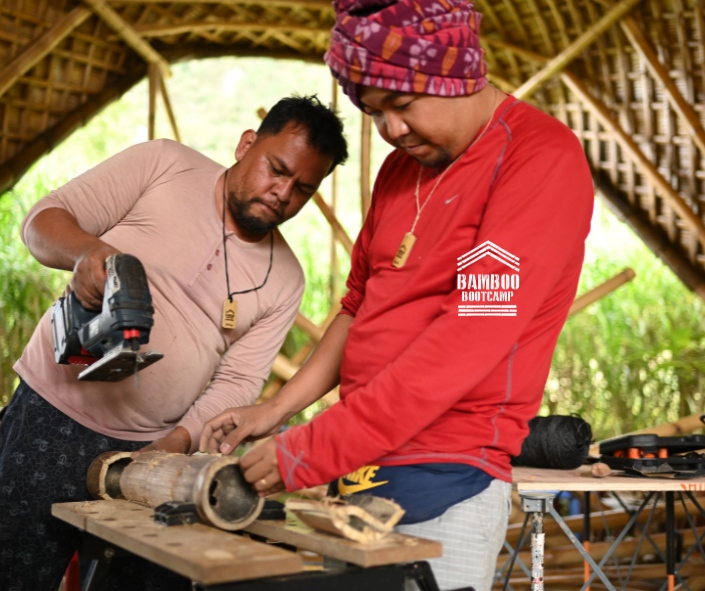
When educational programs like Bamboo Bootcamp set up their training facility at Hayag Farm School in Davao City, they did not just bring in academic lecturers. They partnered directly with Matigsalug knowledge-holders. This integration of indigenous wisdom is what elevates a simple carpentry course into a profound education in true sustainability.
What Indigenous Knowledge Actually Looks Like on a Build Site
When you learn eco-construction from indigenous builders, the entire methodology shifts. You stop fighting the material and start working with it.
1. Harvesting by the Lunar Cycle
A modern developer harvests when the supply chain demands it. An indigenous builder harvests based on the moon. The Matigsalug know that during certain lunar phases, the sap and starch levels in the bamboo culm are at their highest. Harvesting then practically guarantees insect infestation. By timing the harvest to periods of low sap flow, builders drastically increase the natural lifespan of the material before chemical treatment even begins.
2. Designing for the Curve
Bamboo tapers and curves. Instead of discarding “imperfect” poles to find straight ones, traditional builders design structures that utilize the natural arcs. This biomimicry—imitating the organic flow of nature—is what gives biophilic structures their breathtaking, relaxing aesthetic. It is a philosophy of adaptation rather than domination.
3. Friction and Tension Joinery
As mentioned, rigid steel destroys bamboo. Indigenous Filipino carpentry relies on friction, tension, and organic connections.
By using precise “fish mouth” cuts, bamboo pegs, and tight lashing (traditionally with rattan), builders create joints that can flex and sway during typhoons and earthquakes without snapping. The entire structure breathes with the environment.
The Antidote to "Voluntourism"
For gap-year travelers, ethical nomads, and environmentally conscious students, the desire to “give back” is strong. But the travel industry is plagued by “voluntourism”—programs where travelers pay thousands of dollars to paint a fence or lay bricks for a week, often taking jobs away from local workers and leaving no lasting impact.
Ethical travel requires a paradigm shift. It requires moving from a savior complex to a posture of learning.
When you attend a community-rooted eco-construction course, you are not flying in to “fix” a local community. You are paying to learn from them. Your tuition supports their livelihood, validates their generational expertise, and funds the local eco-system. In return, you receive an education in resilience, craftsmanship, and sustainability that you can carry with you for the rest of your life. It is a true, equitable exchange of value.
Building for the Next Generation
Whether you are an entrepreneur planning to develop sustainable hospitality spaces, or simply a traveler wanting to leave a positive footprint for the next generation, you must recognize that sustainability cannot be mass-produced in a factory. It has to be grown, nurtured, and understood.
If we want to build a resilient future, we have to look to the people who have successfully navigated the past.
Ready to learn from the source?
If you are looking for an ethical, hands-on educational experience that goes beyond standard tourism, read our [Ultimate Guide to Bamboo Building Courses]. Discover how you can immerse yourself in traditional Filipino carpentry, support indigenous livelihoods, and master the art of natural building.